How to Verify a Tokunbo Car's History & Specs for Free Using its VIN

Afraid of buying a salvage car or odometer rollback? Here is how to verify any vehicle's specs, detect country of origin, and check histories for free.
Imagine this scenario: You’ve saved up for months, maybe years, to buy a Tokunbo vehicle. You search online and find a sparkling, "accident-free, buy-and-drive" 2016 Lexus RX 350 or Toyota Camry at a dealership in Berger, Lagos.
You go for a physical inspection. The paint is glossy, the AC blows ice-cold, the engine purrs like a kitten, and the seller sprays that signature "strawberry and new car leather" air freshener. It feels perfect. You pay 12 million Naira, drive it home, and receive congratulations from your family.
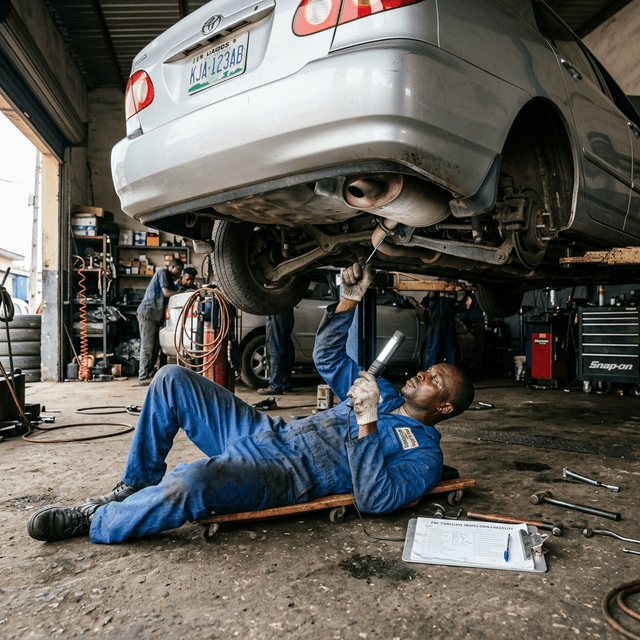
Then, three months later, the steering starts pulling violently to the right. The check engine light comes on, followed by the ABS and airbag lights. You visit a mechanic, who takes one look under the fender and says: "Oga, this car chassis has been welded. The front axle was smashed before."
You run a quick search online and find the original US auction photos. Your heart sinks. The car was actually written off in Texas as a total loss salvage vehicle after a head-on collision that pushed the engine block into the driver's cabin. The local panel beaters just patched it up, sprayed a fresh coat of paint, rolled back the odometer from 190,000 miles to 85,000 miles, and sold it to you as "clean direct used."
You are now driving a rolling coffin.
This is the reality for thousands of car buyers in Nigeria. But you don't have to be the next victim. You can verify the entire history of any imported car—for free—using its Vehicle Identification Number (VIN).
Whether a car was imported from the United States, Canada, Europe (Germany, UK, Belgium), or Asia (Japan, South Korea), here is how to decode its specs, find its origin, and verify its history.
Where Did Your Car Come From? (The 1st Character Hack)
Before checking accident or mileage history, you need to know which country the vehicle was originally manufactured in. Dealers frequently advertise European-spec cars as "American specs" or vice versa.
Every vehicle's 17-character VIN starts with a country identifier (WMI code). You can find the country of origin by looking at the very first character of the VIN:
1,4, or5: Manufactured in the United States2: Manufactured in Canada3: Manufactured in MexicoJ: Manufactured in Japan (very common for Toyota, Lexus, and Honda)K: Manufactured in South Korea (very common for Hyundai and Kia)W: Manufactured in Germany (Mercedes-Benz, BMW, Audi, Volkswagen)S: Manufactured in the United Kingdom (Range Rover, Land Rover)V: Manufactured in France or SpainY: Manufactured in Sweden (Volvo)Z: Manufactured in Italy
Knowing this helps you determine which database you need to query to inspect the vehicle's history.
How to Check History by Country of Origin
Depending on where the car came from, you can use different free methods to verify its past:
1. For US & Canadian Imports (Auction History Lookup)
Over 70% of Tokunbo cars in Nigeria are imported from North America. Most of these cars are purchased from salvage auto auctions like Copart or Insurance Auto Auctions (IAAI).
Standard VIN decoders only show manufacturer specifications, but there is a free workaround to see the original salvage crash photos. When you run a VIN on the Mottars Free VIN Decoder, our system automatically generates custom search shortcuts:
- Google Images Shortcut: It queries the
[VIN] + copart + iaai. Because salvage auctions keep public records, Google crawls and indexes the crash photos forever. You can instantly see the exact physical state of the car before it was shipped to Nigeria. - BidFax Integration: It links you directly to salvage bid history logs where you can see the bid amount, recorded mileage at auction, and original damage type.
2. For United Kingdom Imports (MOT History Check)
If your car was imported from the UK (right-hand drive converted to left-hand drive, or original left-hand drive), it had to pass a mandatory annual safety inspection called the MOT.
The UK Government provides a 100% free MOT history checker online.
- Simply search "Check UK MOT history" online or input the vehicle registration mark.
- It displays the exact mileage recorded every year, details of failed tests, and what parts were worn out or defective.
- This is the most reliable way to spot an odometer rollback on a UK vehicle.
3. For German & European Imports (Belgium, Germany, etc.)
Many premium Mercedes-Benz and BMW vehicles in Nigeria are sourced from European fleet sales or auctions.
- Run the VIN on the Mottars decoder to verify if the model was configured as a commercial vehicle (e.g. taxi, rental car) in Europe, which means it likely has extremely high mileage.
- Inspect panel gaps carefully. In Europe, strict inspection rules make crash repairs expensive, so damaged cars are often shipped to West Africa unrepaired and patched up locally.
4. For Japanese & South Korean Imports (Auction Sheets)
Cars imported directly from Japanese domestic auctions (like USS) come with a detailed Auction Sheet graded from 1 to 5.
- Grade 4.5 or 5 is a clean car. Grade R or RA means the car has repair history from a crash.
- Ask the dealer to show you the original Japanese auction sheet or export certificate. If they claim they "lost" it, be highly suspicious of odometer tampering.
Three Common Dealer Tricks in Nigeria to Watch Out For
1. Trim Level Fraud (Badge Swapping)
Sellers frequently buy the cheapest base model of a vehicle (e.g., a Toyota Camry LE) and paste premium badges (e.g., XLE or SE) on the trunk. They might swap the wheels or install aftermarket leather seats. They then charge you the price of the premium model, cheating you out of millions of Naira.
- Solution: Run the VIN on the Mottars VIN Checker. The manufacturer database will display the exact trim grade the car left the factory with.
2. Odometer Rollback (Mileage Fraud)
A car with 220,000 miles (over 350,000 km) has significant engine and transmission wear. To make it attractive, dealers use digital scanners to rewrite the odometer dashboard chip, showing a mileage of just 75,000 miles.
- Solution: Cross-reference current dashboard mileage with the records on BidFax (for US cars) or the UK MOT history portal.
3. The Deployed Airbag Trap
Replacing blown airbags is extremely expensive. To save money, local repair shops simply stuff the airbag compartments with foam, glue the dashboard covers back together, and wire the warning lights to stay off. In a crash, you will have zero airbag protection.
- Solution: Look at the original salvage photos via our Google Images shortcut. If the photos show the airbags deployed, ask the dealer for proof that the airbags were replaced with genuine modules, or have a diagnostic scanner check the SRS module during inspection.
How to Read US Salvage Titles
When checking the auction history of US cars, look at the Title Type listed in the logs:
| Title Type | What it Means | Verdict |
|---|---|---|
| Clean Title | The car was not written off by insurance. Usually minor cosmetic dents or theft recovery. | Safe to Buy (Verify repairs) |
| Salvage Title | The car suffered damage exceeding 75% of its value. Can be safe if repaired properly. | Proceed with Caution (Inspect frame) |
| Flood / Water Title | The car was submerged in water. Rusts electronics and engine components over time. | Avoid Completely (Silent killer) |
| Junk / Parts Only | The car was declared unbuildable scrap. Often welded together from two different cars. | Avoid Completely (Death trap) |
Your Pre-Purchase Verification Checklist
Before you write any check or make a bank transfer:
- Compare All Physical VINs: Check the dashboard VIN, the doorjamb sticker, the engine block stamp, and the customs clearing documents. They must match exactly.
- Decode the Specs: Run it on Mottars to confirm the trim, year, and country of manufacture.
- Inspect the History: Use our search shortcuts to check for frame damage or odometer adjustments.
- Audit the Customs Duty: Run the car details on the Mottars Customs Duty Calculator to ensure the import duties were paid correctly. Underpaid customs duties can lead to your car being seized by Customs on the highway.
Buying a car is a major investment. Don't let a seller rush you. A legitimate dealer will gladly let you copy the VIN and inspect the car. If a dealer refuses to give you the VIN, walk away immediately.
Spend 5 minutes verifying the VIN today.
Verify Your Vehicle VIN on Mottars Now
Still searching for the right car? Skip the worry of salvage scams by browsing our catalog of pre-screened, verified cars uploaded by trusted dealers: Browse Verified Cars on Mottars.
Related articles
Tinted Glass Permit and Number Plate Rules in Nigeria (2026): What Every Car Owner Needs to Know

Nigeria Customs VIN Valuation System: How to Calculate Your Car Clearing Cost Online

10 Car Dealer Lies Every Nigerian Buyer Must Know (And How to Protect Yourself)
Nigerian Car Buyer's Dictionary: Every Term You Need to Know (Tokunbo, Belgian, First Body & More)