10 Car Dealer Lies Every Nigerian Buyer Must Know (And How to Protect Yourself)

Buying a car in Nigeria can feel like navigating a minefield. We break down the 10 most common lies car dealers tell - and give you a practical checklist to protect yourself.
Buying a car in Nigeria is exciting - and terrifying. You've saved up. You've done your research. You show up at that compound in Berger, Ladipo, or Enugu, and the dealer greets you with a handshake and a wide smile.
What he tells you next could cost you hundreds of thousands of naira.
We've spoken to buyers who paid for "engine-perfect" vehicles and discovered blown head gaskets within a week. Buyers who were told a car was "first body" only to find accident history hidden under fresh paint. Buyers who felt too embarrassed to push back - and paid the price.
This guide exists so you don't become one of those stories.
Here are the 10 most common lies car dealers tell in Nigeria - and exactly how to protect yourself from each one.
1. "The Engine Is Perfectly Clean - No Problem At All"
This is the most common lie in Nigerian car markets. A dealer saying "engine perfect" means almost nothing without independent verification.
What it really means: The car started this morning and didn't smoke in front of you. That's it.
What to do:
- Request a full engine scan with an OBD2 diagnostic scanner (any mechanic worth their salt carries one). It reads engine fault codes in minutes.
- Ask to see the dipstick. Are there brown, frothy bubbles? That's coolant mixing with oil - a classic head gasket failure warning.
- Check the coolant reservoir. Brown or rusty coolant means the cooling system is neglected.
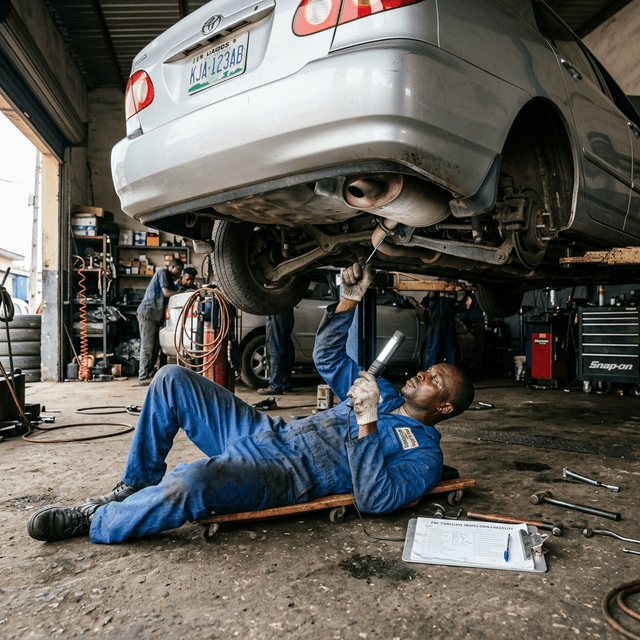
- Take the car to a neutral mechanic - not one the dealer recommends. If the dealer won't allow an independent inspection, walk away. Full stop.
💡 Mottars tip: Buy from a verified Mottars dealer. Our verified dealers have undergone business vetting processes to ensure you are dealing with a legitimate business. Look for the blue verified badge on the listing.
2. "It's First Body - Never Had Any Accident"
"First body" is the Nigerian car market's most abused term. It means the car has never been in an accident. But paint and bodywork lie all the time.
What it really means: The bodywork looks straight - but that doesn't mean it was never hit.
How to spot hidden accident damage:
- Run a magnet along panel edges and door seams. Factory metal will attract the magnet strongly; body filler (used to hide dents) will barely hold it.
- Look for uneven paint texture or slight colour differences between panels in direct sunlight.
- Check the door gaps: if they're uneven or one door feels stiffer than another, the frame may have been bent and repaired.
- In the boot, look under the carpet for signs of crumpling or repainted metal.
- Check the engine bay: look for paint overspray on rubber seals or bolts that look like they've been removed and re-tightened.
3. "This Car Has Very Low Mileage"
You see the odometer reads 82,000 km. Sounds great for a 2018 car. But odometer rolling (also called clocking) is common - especially in tokunbo vehicles that pass through multiple countries before reaching Nigeria.
How to verify mileage:
- Look at pedal wear. A car with 80,000 km should have moderate wear on the clutch, brake, and accelerator pedals. If pedals look nearly new on a supposedly well-used car, the mileage doesn't add up.
- Check seat wear and steering wheel leather. High-mileage cars show it.
- Ask for the original auction sheet if the car came from Japan. Legitimate tokunbo importers can provide this - it shows the vehicle's actual graded condition and mileage at the time of auction.
- For newer vehicles, request service history stamps. Even partial records help cross-reference mileage.
4. "It's Direct Tokunbo - It Never Touched Nigerian Roads"
"Direct tokunbo" is premium pricing language. It implies the car came straight from Japan, UK, or the US without being driven in Nigeria before. But many "direct tokunbo" cars have been in Nigeria for months, quietly racking up kilometres.
The reality check:
- Ask for the shipping documents and arrival date. Legitimate importers have these.
- Check the Nigerian Customs receipt. If the car was "shipped in last week" but the customs clearance date is six months ago, you have your answer.
- Look for Nigerian road dust patterns in hard-to-clean areas: behind the rear wheels, under the chassis.
5. "It's a Belgian - The Best Grade You Can Get"
In Nigerian car parlance, "Belgian" refers to tokunbo cars shipped from Belgium - supposedly the cleanest, lowest-mileage vehicles because Belgian owners drive modestly. This has become a sales fantasy.
What you need to know:
- Belgium is a distribution hub, not a guarantee of quality. Cars from all over Europe pass through Belgian ports.
- A legitimate "Belgian" car should have European inspection papers and, ideally, a vehicle history report from a European VIN checker.
- Ask for a carVertical or AutoDNA report for European cars. These services trace the vehicle's history across multiple countries.
6. "Don't Worry, the Parts Are Available Everywhere"
A dealer selling you a 2009 Toyota Avalon or a Pontiac Solstice will swear on his mother that parts are available everywhere in Lagos. They are not.
Before you buy:
- Search for the car's specific model on Jiji, Jumia, and at Ladipo Market online groups. Can you find common wear parts (brake pads, filters, sensors)?
- Ask the dealer to name three parts shops in your city that stock parts for that specific model year. Watch his face.
- For less-common brands (Pontiac, Saturn, older Chrysler models), factor in a potential long wait time and high import cost for any serious repair.
Safe bets for parts availability in Nigeria: Toyota (Camry, Corolla, Highlander, Land Cruiser), Honda (Accord, CR-V), Lexus (ES, RX), Mercedes C and E class, Hyundai (Elantra, Tucson).
7. "The AC Works - It Just Needs a Small Gas Refill"
Air conditioning repair in Nigeria is expensive. A full AC system regas and repair can cost ₦80,000–₦300,000 depending on the problem. "Small gas refill" is a way of minimising that.
What to do:
- Run the AC for at least 15 minutes on maximum. Does it cool the car properly? Does it smell musty (suggesting mould in the evaporator)?
- Ask to hear the compressor engage. You should hear a faint click when you turn on the AC and feel slight engine drag.
- If the AC "just needs gas," ask the dealer to have it gassed before you pay. If he refuses, price in the repair cost before negotiating.
8. "The Price Is Fixed - This Is the Best Deal in the Market"
There is almost no such thing as a fixed price in the Nigerian car market. "Fixed price" is a psychological anchor - meant to stop you from negotiating.
How to negotiate effectively:
- Research the car's actual market price before you visit. Check Jiji, Cars45's archived listings, Autochek, and Mottars to understand the realistic price range for that year, mileage, and condition.
- Know your walk-away number before you arrive. Name a figure below it and work up.
- Identify legitimate faults during inspection (minor dents, tyre wear, the AC issue you spotted) and use each as a negotiation point.
- Bring cash or show proof you can pay. Dealers are more flexible when they know the money is real and immediate.
9. "The Papers Are Complete - Everything Is in Order"
"Complete papers" should mean: proof of ownership, customs duty clearance (for imported vehicles), valid road worthiness certificate, insurance, and ideally a FRSC plate.
What to actually verify:
- Proof of ownership: Make sure the name on the vehicle papers matches the person selling the car. If it doesn't, ask for a deed of assignment proving the chain of ownership. Without this, you're buying a legal headache.
- Customs clearance: For tokunbo cars, confirm the vehicle hasn't been declared as abandoned goods or seized at the port.
- Chassis number (VIN): Match the VIN on the dashboard, the engine bay, and the door frame with what's on the papers. Altered VINs are a red flag for stolen vehicles.
- FRSC verification: You can verify Nigerian-plated vehicles through the FRSC VIO portal to check if the plate is legitimately assigned to that chassis.
10. "This Price Won't Last - Another Buyer Is Coming This Afternoon"
The phantom buyer is the oldest closing trick in car sales. The pressure to "buy now before someone else takes it" has pushed thousands of Nigerian buyers into rushed decisions they regretted.
The antidote:
- If the car is worth buying today, it will still be worth buying after inspection. A real inspection takes 1–2 hours. A deceptive dealer won't allow it; an honest one will.
- If another buyer really is coming, let them come. A car that's right for you will still be right for you tomorrow. A rushed purchase on a bad car is a problem for years.
- Offer a small refundable holding fee (₦10,000–₦20,000) to take the car off market for 24 hours while you complete your inspection. A confident dealer accepts this.
Your Complete Car Buying Safety Checklist
Before you hand over a single naira, run through this:
🔍 Physical Inspection
- Magnet test on all body panels for filler
- Engine dipstick check (milky = head gasket issue)
- Coolant colour check (should be green or orange, not brown)
- All panel gaps even and consistent
- Tyre wear even across all four tyres
- AC runs cold for 15+ minutes
- All electric windows, mirrors, and locks work
- No visible rust on chassis underside
📋 Documents
- VIN matches dashboard, engine bay, door frame, and papers
- Proof of ownership in seller's name (or valid deed of assignment)
- Customs clearance certificate (for tokunbo)
- Road worthiness certificate (valid, not expired)
- Receipt or history of previous ownership if available
🔧 Mechanic's Assessment
- OBD2 engine scan - zero serious fault codes
- Neutral mechanic (not dealer-recommended) confirms overall condition
- Gearbox shifts smoothly (test all gears, including reverse)
- No unusual sounds under acceleration or braking
- Brakes don't pull to one side
💰 Price & Negotiation
- Market price researched on at least three platforms
- Identified faults documented for negotiation
- Walk-away price set before negotiation begins
Buy with Confidence on Mottars
Mottars is Nigeria's trusted automotive marketplace - built specifically to solve the trust problem in Nigerian car buying.
Every listing on Mottars from a verified dealer has:
- ✅ A clear dealer verification badge
- ✅ Full specs listed (mileage, condition, transmission, fuel type)
- ✅ Direct contact via WhatsApp or in-app messaging
- ✅ Inspection-ready listings you can request an independent check on
You can also use our Request a Car feature to tell us exactly what you're looking for - and our verified partners will reach out with matching vehicles.
Browse verified cars on Mottars →
Request a specific car →
Key Takeaways
- "Engine perfect" means nothing without an OBD2 scan and independent mechanic review
- Always do the magnet test - body filler won't fool a magnet
- Verify papers thoroughly - VIN must match everywhere
- The phantom buyer is fake - never rush a purchase
- Mileage can be rolled back - check pedal and seat wear as a cross-reference
- Inspection is non-negotiable - walk away from any dealer who refuses it
Published by the Mottars Editorial Team. Have a car buying story or question? Contact us or find us on Instagram @mottarsofficial_.
Related articles
Tinted Glass Permit and Number Plate Rules in Nigeria (2026): What Every Car Owner Needs to Know

Nigeria Customs VIN Valuation System: How to Calculate Your Car Clearing Cost Online

How to Verify a Tokunbo Car's History & Specs for Free Using its VIN
Nigerian Car Buyer's Dictionary: Every Term You Need to Know (Tokunbo, Belgian, First Body & More)